
Yoga for Tight Hips Men 30+: A Therapeutic Solution for Sitting-Induced Stiffness
If you are a man over 30 with a desk job, long driving hours, or minimal movement during the day, your hips are likely the silent victim.
Tight hips are not just a flexibility issue. They are a biomechanical dysfunction that affects:
Lower back health
Knee tracking
Pelvic alignment
Athletic performance
Even sexual health and circulation
Most men try to “stretch more.” That rarely solves the root cause.
In this guide, I’ll break down yoga for tight hips men from a therapeutic lens — focusing on anatomy, neuromuscular control, fascia, and joint mechanics — not generic fitness stretching.
Why Men Over 30 Develop Tight Hips (The Real Biomechanics)
1. Chronic Hip Flexion from Sitting
When you sit for 6–10 hours daily:
The hip joint stays in ~90° flexion
The iliopsoas adapts to shortened length
The anterior capsule stiffens
Gluteus maximus becomes neurologically underactive
Over time, your body doesn’t just “feel tight.” It reorganizes structurally.
The hip flexors shorten.
The glutes inhibit.
The pelvis tilts anteriorly.
The lumbar spine compensates with extension.
This creates:
Lower back compression
Hamstring tension (protective guarding)
Reduced hip internal rotation
2. Loss of Internal Rotation (The Hidden Problem)
Most men focus on hamstrings.
The real issue is usually loss of hip internal rotation.
Internal rotation is essential for:
Walking mechanics
Running efficiency
Squatting safely
Rotational strength
Without it, the knee absorbs rotational stress — leading to pain over time.
3. Fascia Stiffness and Tissue Hydration
After 30, collagen cross-linking increases.
If you’re sedentary, fascial tissues around:
Tensor fascia lata (TFL)
Adductors
Deep rotators
become less elastic.
This isn’t solved by aggressive stretching.
It requires:
Controlled loading
Breath work
Neuromuscular re-education
That’s where therapeutic yoga becomes powerful.
What “Yoga for Tight Hips Men” Should Actually Include
Most YouTube routines show:
Random pigeon pose
Forced splits
Aggressive lunges
That approach ignores joint mechanics.
A therapeutic sequence must restore:
Hip extension
Internal rotation
Glute activation
Pelvic neutrality
Breath-driven mobility
Let’s break it down properly.
Phase 1: Restore Pelvic Position
Before stretching hips, correct pelvic orientation.
1. Constructive Rest with Diaphragmatic Breathing
Why this matters:
Chronic sitting locks pelvis into anterior tilt.
Diaphragmatic breathing restores intra-abdominal pressure.
Pelvic floor and deep core re-engage.
Biomechanics:
The diaphragm attaches to lumbar spine.
When breathing is shallow (chest dominant), lumbar stabilization decreases.
Proper breath improves hip joint centration.
This is foundational before moving into deep hip work.
Phase 2: Reclaim Hip Extension (Undo Sitting Damage)
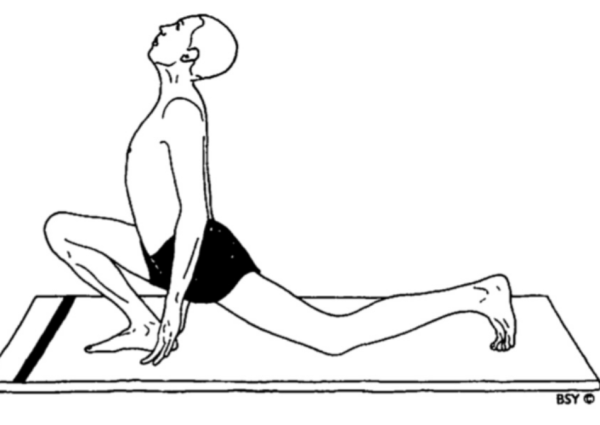
Low Lunge with Posterior Pelvic Tilt Focus
Most men perform lunges incorrectly.
Common mistake:
Arching the lower back instead of extending the hip.
Correct cue:
Slight tuck of pelvis
Engage glute of back leg
Lift through sternum without lumbar compression
Target:
Psoas
Rectus femoris
Anterior hip capsule
This restores true hip extension instead of spinal compensation.
Phase 3: Restore Internal Rotation
90/90 Hip Rotation (Active Control)
Internal rotation is the missing link in most programs.
In 90/90:
Front leg works external rotation.
Back leg trains internal rotation.
Trunk remains upright (no collapse).
Add:
Forward hinge over front leg
Active lift attempts of back foot
This builds strength at end range — not just flexibility.
Research in mobility science consistently shows that active end-range control creates more sustainable flexibility gains than passive stretching alone.
Phase 4: Controlled External Rotation (Without Joint Stress)
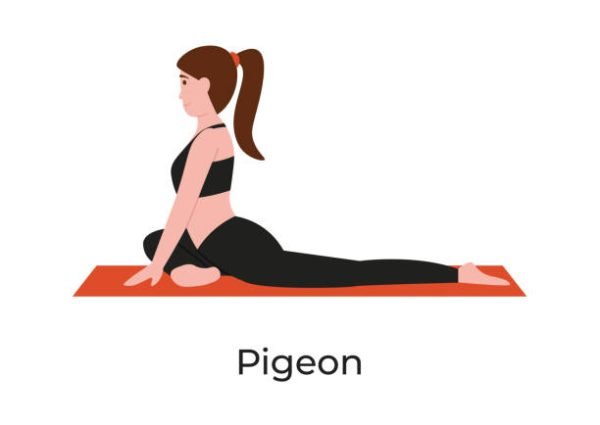
Modified Pigeon with Support
Why supported?
Men with tight hips often force pigeon and stress the knee.
Therapeutic cues:
Shin not necessarily parallel
Support under hip
Neutral spine
Slow nasal breathing
Goal:
Open posterior capsule gradually without ligament strain.
Phase 5: Glute Re-education
Bridge Pose with Isometric Hold
If glutes don’t fire, hip tightness returns.
In bridge:
Feet hip-width
Slight posterior tilt
Hold 20–30 seconds
Avoid lumbar hyperextension
This retrains:
Gluteus maximus
Deep hip stabilizers
Posterior chain integration
How Often Should Men Over 30 Practice?
For real change:
4–5 days per week
20–30 minutes minimum
Slow tempo
Breath-driven transitions
Mobility is a neurological adaptation, not just tissue length change.
Within 4–6 weeks, most men report:
Reduced lower back stiffness
Improved squat depth
Better posture
Easier walking stride
Signs Your Hip Tightness Is Becoming a Bigger Problem
If you experience:
Persistent lower back tightness in mornings
Knee pain during stairs
Uneven stride
Difficulty sitting cross-legged
Reduced rotational power in sports
It’s not just “aging.”
It’s hip dysfunction.
Common Mistakes Men Make When Trying to Fix Tight Hips
Overstretching hamstrings
Ignoring internal rotation
Forcing deep pigeon
Skipping breath work
Not strengthening end ranges
Yoga must be therapeutic — not ego-driven.
FAQ: Yoga for Tight Hips Men
Men generally have:
Deeper acetabular sockets
Thicker connective tissue
Less natural external rotation
Hormonal differences also affect tissue elasticity.
Yes. Limited hip extension forces lumbar spine to compensate, increasing compression stress.
With structured practice:
4–8 weeks for noticeable improvement.
Consistency matters more than intensity.
Only with proper alignment and support. Unsupported deep pigeon may strain knees.
Both can coexist.
But if hip mobility is restricted, strength training without mobility correction may worsen compensation patterns.
Final Word: Tight Hips Are a Structural Issue, Not Just Stiffness
If you are a man 30+ working long hours, tight hips are predictable — but reversible.
The solution isn’t random stretching.
It’s structured, biomechanically sound therapeutic yoga.
As a yoga therapist with 6+ years of clinical experience working with adult men, I don’t teach generic flows. I teach corrective sequences that:
Restore joint mechanics
Improve mobility without injury
Protect your lower back
Build strength at end range
if this article resonates with you, the next step is guided implementation.
My online group therapeutic yoga classes are designed specifically for:
Men with desk jobs
Early-stage lower back discomfort
Hip stiffness after 30
Busy professionals needing structured guidance
Small group format.
Biomechanics-focused sessions.
Corrective cueing.
If you’re serious about restoring your mobility instead of temporarily stretching — join the program.
 Apply to join group class or one-on-one sessions at Soulkaya
Your hips don’t need more force.
They need intelligent retraining.