
Yoga Isn’t What You Think
When you walk into most modern yoga studios, you see movement:
Flowing sequences, stretching, strengthening, balancing, sweating.
But if you travelled back 2,000 years and met an ancient yogi, you’d witness something completely different.
You’d see a person sitting still — quietly, steadily, for hours.
Why?
Because classical yoga was never built on movement.
It was built on stillness.
This blog uncovers why seated postures dominated traditional yoga, what “āsana” originally meant, and how modern neuroscience now validates the wisdom of ancient yogis.
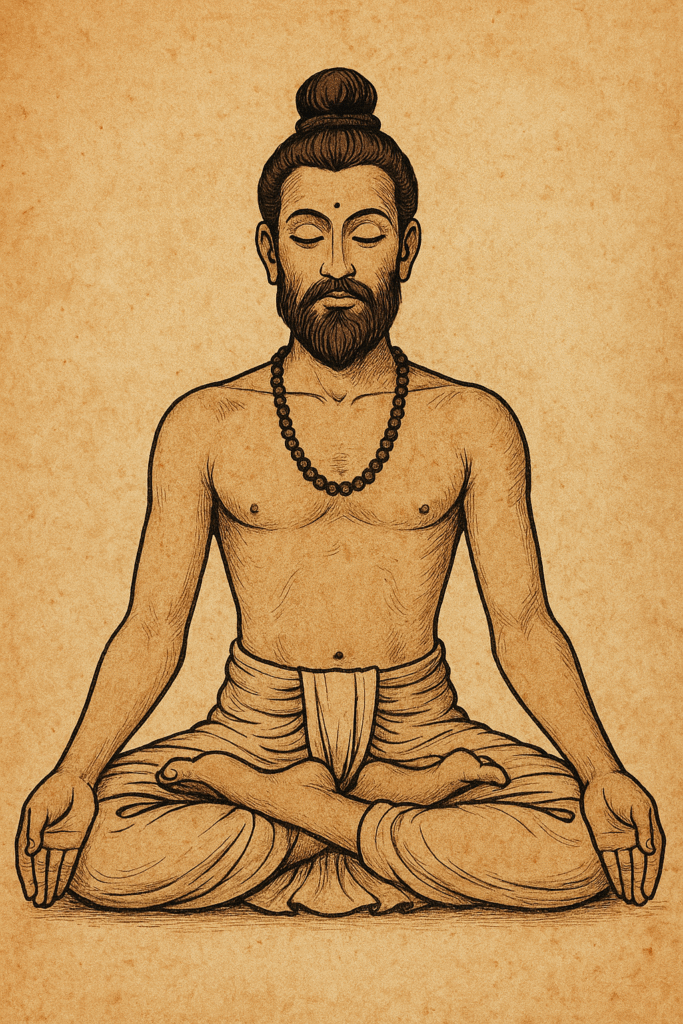
1. What “Āsana” Actually Meant in Ancient Yoga
Today, āsana means “posture.” But in classical yoga, it meant only one posture:
a stable, comfortable seat for meditation.
Patañjali, the earliest systematizer of yoga, gave only one definition:
“Sthira sukham āsanam.” — Yoga Sūtra 2.46
A posture that is steady and comfortable.
This definition doesn’t describe poses, stretches, or flexibility.
It describes a state of being — not movement.
To Patañjali, the entire purpose of the body was to support the mind.
A distracted or uncomfortable body disrupts meditation, so the yogi trains the body to sit without pain, without effort, without tension.
In short:
Modern yoga: āsana = movement
Classical yoga: āsana = stillness
2. Why Early Yogis Prioritized Stillness Over Flexibility
Ancient yogis weren’t athletes or performers.
They were mind-scientists, experimenting with consciousness.
Their goal wasn’t to stretch the hamstrings.
Their goal was to understand the mind.
Stillness helped them:
✓ Reduce sensory distractions
A quiet body prevents unnecessary signals from overwhelming the nervous system.
✓ Maintain energy (prāṇa) within
Movement disperses energy; stillness consolidates it for meditation.
✓ Deepen breath awareness
Calm breathing becomes easier when the body stops moving.
✓ Enter higher mental states
Sustained stillness trains attention — the foundation of meditation.
For ancient yogis, if you couldn’t sit still, you couldn’t meditate.
If you couldn’t meditate, you couldn’t practice yoga.
That’s why the body was trained not for flexibility, but for stability and endurance.
3. What Classical Texts Actually Say About Meditation Posture
Let’s break down the sources:
Yoga Sūtra — The Body Serves the Mind
Beyond the simple definition of āsana, the sutras emphasize:
Relaxation of effort
Absorption of the mind in the infinite
A sense of natural ease
To Patañjali, the seat must be so effortless that the mind can turn inward without distraction.
📖 Read: https://archive.org/details/yogasutrasofpata00pata
Bhagavad Gītā — A Manual for Meditation Posture
Chapter 6 describes the exact meditation posture:
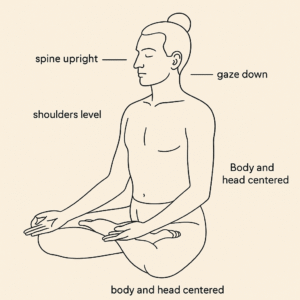
Spine upright and steady
Body aligned and balanced
Gaze down or toward the nose
Mind anchored
Breath natural
Krishna emphasizes that posture creates the foundation for mental discipline.
📖 Read: https://www.holy-bhagavad-gita.org/chapter/6
Haṭha Yoga Pradīpikā — Master One Seat, Master Meditation
Contrary to modern belief, Haṭha Yoga is not just about poses.
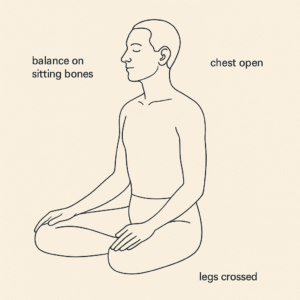
The Pradīpikā states that mastering just one seated pose—like Siddhāsana or Padmāsana—is enough to progress spiritually.
A stable seat is considered the king of all āsanas.
📖 Read: https://archive.org/details/HathaYogaPradipika_201601
Śāṇḍilya Upaniṣad — Stillness Leads to Inner Silence
This text explains the inner mechanics:
Still body → calm prāṇa
Calm prāṇa → steady mind
Steady mind → meditation becomes natural
Stillness is not physical laziness — it is energetic alignment.
📖 Read:
https://www.wisdomlib.org/hinduism/book/the-upanishads-vol-2/d/doc122559.html
4. How Modern Neuroscience Confirms Ancient Yogic Wisdom
Ancient yogis didn’t have MRI machines, but they understood something profound:
When the body becomes still, the mind becomes powerful.
Today, science agrees.
NCCIH Research:
Yoga’s greatest benefits are psychological, not physical —
reduced anxiety, better emotional regulation, improved attention.
🔗 https://www.nccih.nih.gov/health/yoga
Harvard Medical School:
Slow breathing + stillness:
Lowers stress hormones
Improves mood
Supports heart and brain health
🔗 https://www.health.harvard.edu/mind-and-mood/yoga-for-better-mood
Frontiers in Psychology:
Stillness-based mindfulness practices enhance:
Cognitive control
Emotional balance
Focus and decision-making
🔗 https://www.frontiersin.org/articles/10.3389/fpsyg.2019.00314/full
Journal of Clinical Neurophysiology:
Breathwork changes brainwaves and regulates neural networks involved in:
Attention
Stress
Emotion
🔗 https://journals.lww.com/clinicalneurophys/Fulltext/2017/01000/Breathing_and_the_Brain.2.aspx
5. The Core Truth: Yoga Was Never About Flexibility
The more you explore classical texts, the more obvious it becomes:
Yoga is a mental discipline supported by the body — not a physical discipline supported by the mind.
When the body is steady, the mind can dive inward.
When the mind dives inward, yoga happens.
This is why ancient yogis sat still.
This is why meditation was the heart of practice.
This is why āsana originally meant a seat, nothing more.
6. Why This Matters Today
Modern yoga has many benefits, but it often loses its original purpose.
By understanding the roots of āsana, you help students reconnect with the deeper meaning of yoga:
Yoga is not performance.
Yoga is not aesthetics.
Yoga is not flexibility.
Yoga is the art of mastering the mind.
And the first step to mastering the mind is learning to sit — steady, relaxed, aware.
Thank you for reading and exploring the deeper truth of yoga with me.
If this blog inspired you, imagine what a consistent guided practice can do for your mind and body.
At Soul Kaya, I offer personalized online yoga sessions that focus on real yoga—breath, awareness, strength, and mental clarity.
🌿 Join Soul Kaya Yoga Classes
🌿 Begin your journey toward balance and transformation
I look forward to welcoming you to the Soul Kaya family.