
Why Classical Yoga Was Designed for Mental Mastery, Not Physical Fitness
Introduction: Yoga Was Never About the Body First
In today’s world, yoga is often reduced to stretching, sweating, flexibility, and aesthetics. Social media has transformed yoga into a performance of postures.
But classical yoga never began with the body as the final goal.
Ancient yogis identified something far more powerful — and dangerous — than a stiff body:
👉 The restless, uncontrolled mind.
From the Upaniṣads to the Bhagavad Gītā, from Patañjali to Haṭha yogic texts, yoga was developed as a system to understand, discipline, and purify mental activity — known as vṛtti.
The Core Insight of Classical Yoga: The Mind Creates Bondage and Freedom
All classical yogic systems agree on one fundamental truth:
The mind is both the cause of suffering and the doorway to liberation.
Yoga Sūtra 1.2 — The Definition of Yoga
Yogaś citta-vṛtti-nirodhaḥ
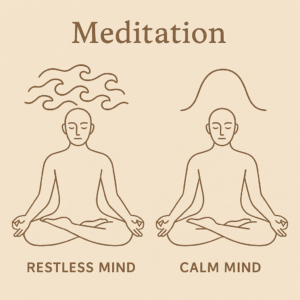
Yoga is the cessation of fluctuations of the mind.
📖 Source (English translation):
https://www.swamij.com/yoga-sutras-10104.htm
Notice something important here:
Yoga is not defined as posture
Yoga is not defined as flexibility
Yoga is defined as mental stillness
Asana, prāṇāyāma, ethics, and meditation exist only to serve this purpose.
Why Ancient Yogis Saw the Mind as the “Enemy”
Bhagavad Gītā 6.5–6 — The Mind as Friend or Enemy
“For him who has conquered the mind, the mind is the best of friends.
But for one who has failed to do so, the mind will remain the greatest enemy.”
📖 Source:
https://www.holy-bhagavad-gita.org/chapter/6/verse/5
https://www.holy-bhagavad-gita.org/chapter/6/verse/6
Krishna does not speak about muscles or posture here.
He speaks about mental mastery.
An uncontrolled mind:
jumps between fear and desire
lives in past regret and future anxiety
constantly reacts, compares, and craves
Yoga was created to train this wild mental energy, not decorate the body.
Upaniṣadic Wisdom: The Mind as the Inner Charioteer
Katha Upaniṣad — The Chariot Analogy
The body is the chariot
The senses are the horses
The mind is the reins
The intellect is the charioteer
If the reins (mind) are loose, the horses (senses) run wild.
📖 Source:
https://www.esamskriti.com/e/Spirituality/Upanishads/Katha-Upanishad-Chariot-Analogy-1.aspx
This metaphor clearly shows:
The problem is not the body
The problem is lack of mental direction
Yoga trains the reins.
Haṭha Yoga: The Body as a Tool, Not the Goal
Many people misunderstand Haṭha Yoga as “physical yoga.”
Haṭha Yoga Pradīpikā (2.2)
“When the breath is restless, the mind is restless.
When the breath is steady, the mind becomes steady.”
Source:
https://www.sacred-texts.com/hin/hyp/hyp02.htm
Here, asana and prāṇāyāma are technologies — not performances.
They exist to:
stabilize the nervous system
regulate prāṇa
quiet mental turbulence
The body was trained only to support mental stillness.
What Modern Neuroscience Confirms Today
What ancient yogis realized intuitively, modern science now validates.
1. Yoga Reduces Stress Reactivity (Harvard Medical School)
Yoga down-regulates the sympathetic nervous system and improves emotional regulation.
🔗 https://www.health.harvard.edu/staying-healthy/yoga-for-better-mental-health
2. Yoga’s Strongest Benefits Are Mental (NCCIH – NIH)
The National Center for Complementary and Integrative Health confirms:
Yoga’s most consistent benefits are psychological and emotional.
🔗 https://www.nccih.nih.gov/health/yoga-what-you-need-to-know
3. Emotional Regulation & Attention Improve
Frontiers in Psychology shows yoga enhances:
focus
emotional stability
self-regulation
🔗 https://www.frontiersin.org/articles/10.3389/fpsyg.2018.00491/full
4. Breathwork Calms the Default Mode Network
Neuroscience research shows controlled breathing reduces default-mode overactivity — the brain network linked to overthinking and anxiety.
🔗 https://www.ncbi.nlm.nih.gov/pmc/articles/PMC6137615/
Exactly what yogic texts described as vṛtti nirodha.
The Deepest Purpose of Yoga: Mental Purification
Yoga is not about fighting the mind.
It is about understanding its patterns, calming its waves, and seeing clearly.
When the mind becomes still:
perception becomes sharp
emotions settle
decisions become conscious
inner clarity arises naturally
This is why yoga was always a mind science supported by the body, not the other way around.
Final Reflection
Yoga does not ask you to become flexible.
Yoga asks you to become aware.
The real enemy yoga targets is not stiffness, weight, or weakness —
it is unconscious mental restlessness.
And when the mind is mastered, the body follows effortlessly.
If this article helped you see yoga beyond postures,
share it with someone who thinks yoga is just stretching.
And if you want to experience yoga as a mental training system, not a workout —
you’re welcome to practice with me.