
Yoga Is NOT About Flexibility
Yoga Isn’t What You Think
When most people hear the word yoga, they imagine extreme flexibility, acrobatic postures, and Insta-perfect shapes.
But this is a modern misunderstanding.
Historically — in the Vedas, Upanishads, Bhagavad Gītā, Yoga Sūtra, Haṭha Yoga texts — yoga was never about touching your toes.
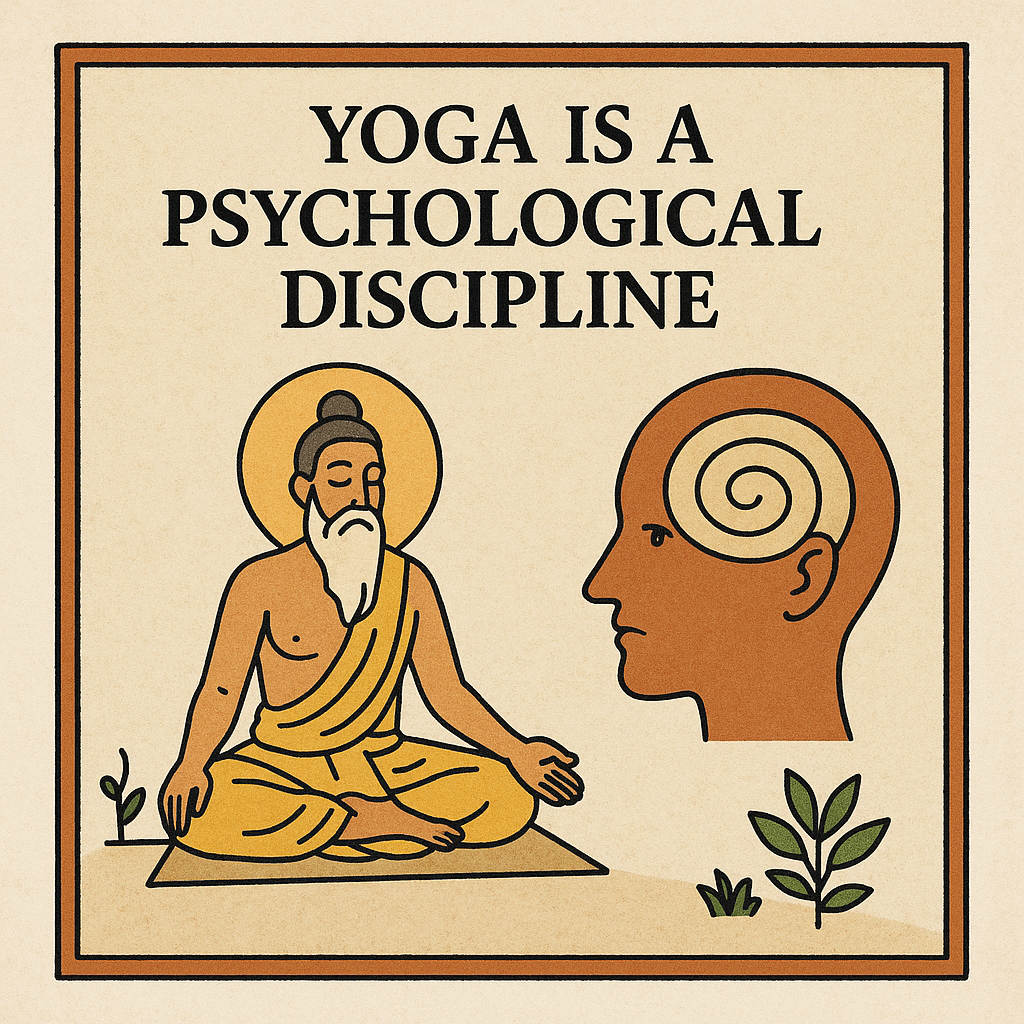
It was a psychological discipline, a method of mental purification, and a science of consciousness.
Flexibility of the hamstrings is optional.
Flexibility of the mind is essential.
1. Flexibility Is Not the Goal of Yoga
Classical texts are very clear: Yoga is a mental discipline
Most ancient texts mention only a few basic postures — mainly for sitting steadily during meditation.
Haṭha Yoga Pradīpikā — Chapter 1
Even though this is considered a physical-practice text, it lists very few āsanas and immediately shifts the focus to prāṇāyāma and dhyāna.
“Haṭhasya prathamāṅgaṁ tu āsanaṁ pūrvam ucyate.”
Haṭha Yoga begins with āsana — but only as a preparation (for higher limbs).
— HYP 1.17
In the same chapter, Svātmārāma states the goal:
“Āsanaṁ sthairyamarogyaṁ cāṅga-lāghavaṁ.”
Āsana is for stability, health, and lightness of limbs — not flexibility.
— HYP 1.19
2. What Yoga Sūtra 1.2 Actually Says
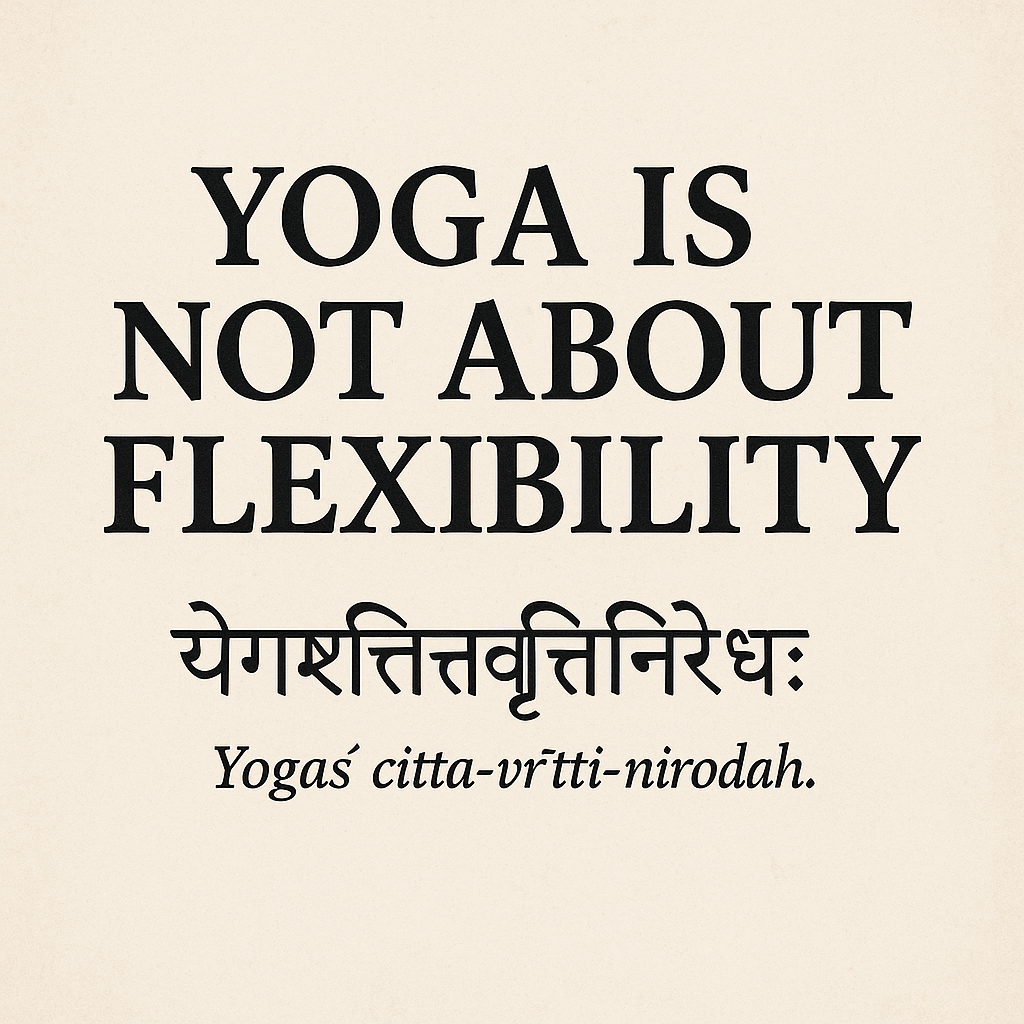
Patañjali — the authority for classical yoga — defines yoga in one sentence:
“योगश्चित्तवृत्तिनिरोधः”
Yogaś citta-vṛtti-nirodhaḥ.
— Yoga Sūtra 1.2
Meaning:
Yoga is the stilling, regulating, and mastering of the fluctuations of the mind.
Nothing about flexibility.
Nothing about performing poses.
This single sūtra proves:
Yoga = Psychology + Mind Training, not gymnastics.
3. Bhaagavad Gītā — Yoga as Equanimity, Mind Control & Skillful Living
The Gītā mentions yoga more than 100 times — never as a stretching exercise.
Gītā 2.48 — Yoga is equanimity
“योगस्थः कुरु कर्माणि… समत्वं योग उच्यते।”
Established in yoga, perform action.
Equanimity is called yoga.
Gītā 6.23 — Yoga is freedom from mental disturbances
“तं विद्यात् दुःखसंयोगवियोगं योगसंज्ञितम्।”
Yoga is the disconnection from union with suffering.
Gītā 6.12 — Purpose of seat (āsana)
“तत्रैकाग्रं मनः कृत्वा…”
The purpose of the seat is to make the mind one-pointed.
Again — yoga = mental mastery.
4. Gheranda Samhita — Yoga as a 7-Step System of Purification
Gheraṇḍa Muni describes yoga as sapta-sādhana, a 7-stage process:
Śodhana — purification
Dṛḍhatā — strengthening
Sthiratā — steadiness
Mūrtitva — lightness of body
Pratyakṣa — control of senses
Dhyāna — meditation
Samādhi — absorption
Only one chapter is on āsana.
Gherand Samhita 2.1
“Āsanaṁ sthirataṁ kurute.”
Āsana creates steadiness.
Steadiness — not flexibility.
5. Vedic & Upanishadic View — Yoga as Inner Union
Katha Upanishad 6.11
“यदा पञ्चावतिष्ठन्ते…”
When all the senses are at rest, the mind becomes still — this is the highest yoga.
Shvetāshvatara Upanishad 2.10
“यो योगेनात्मानं वेत्ति…”
One who knows the Self through yoga…
The Vedas talk about self-realization, not performing poses.
6. Why Ancient Yogis Practiced Minimal Postures
All classical sources agree:
The body must be stable
Breath must be regulated
Mind must be quiet
Consciousness must be elevated
Advanced postures are not required for this.
Most ancient yogis practiced:
Sukhasana
Padmasana
Vajrasana
— primarily to sit for 1–2 hours without discomfort during meditation.
7. Modern Science Now Agrees With Ancient Yoga
Modern research consistently shows that yoga’s primary benefits are mental & nervous-system based — not flexibility based.
Harvard Medical School
Yoga reduces stress, improves emotional regulation, and supports the parasympathetic nervous system.
Link: https://www.health.harvard.edu/staying-healthy/yoga-benefits-beyond-the-mat
Frontiers in Psychology
Yoga improves cognitive control, reduces anxiety, and balances the autonomic system.
Link: https://www.frontiersin.org/articles/10.3389/fpsyg.2019.00620/full
NIH / NCCIH
Research shows yoga helps with stress, back pain, anxiety, and mental well-being — not flexibility alone.
Link: https://www.nccih.nih.gov/health/yoga-what-you-need-to-know
Ancient yogis knew this thousands of years ago.
8. Why “Not Flexible” Means Nothing About Your Yoga Practice
If you’re stiff — congratulations.
You’re the exact person yoga was originally designed for.
Classical yoga only demands:
A steady seat
A calm breath
A stable mind
Flexibility is a side-effect, not a requirement.
Yoga doesn’t care how far you bend.
Yoga cares whether your mind wavers.
Conclusion: Yoga Is a Mind Discipline — Not a Flexibility Contest
Across all texts — Veda, Upanishad, Gītā, Yoga Sūtra, Haṭha Yoga Pradīpikā, Gheraṇḍa Samhita — the message is the same:
Yoga is mastery of the mind. Flexibility is optional.
If you can’t touch your toes, you are still 100% capable of practicing and benefiting from yoga.
If anything — stiff people often learn yoga faster because they focus on the essence, not the aesthetics.
REFERENCES (SOLID, RELIABLE, EDUCATIONAL)
Primary Texts
Yoga Sūtra 1.2 — Yoga is mind-regulation
Haṭha Yoga Pradīpikā 1.17–1.19 — Asana is for stability
Bhagavad Gita 2.48, 6.12, 6.23 — Yoga is equanimity & mental mastery
Gheranda Samhita 2.1 — Asana creates steadiness
Katha Upanishad 6.11 — Yoga is stillness of senses
Shvetashvatara Upanishad 2.10 — Yoga as self-knowledge
Modern Scientific Research
Harvard Medical School — Yoga & mind-body benefits
https://www.health.harvard.edu/staying-healthy/yoga-benefits-beyond-the-matFrontiers in Psychology — Yoga & emotional/cognitive regulation
https://www.frontiersin.org/articles/10.3389/fpsyg.2019.00620/fullNIH / NCCIH — Evidence-based yoga benefits
https://www.nccih.nih.gov/health/yoga-what-you-need-to-know